
From Hammurabi to Modern Courts The Epic History of Legal Systems

Law began as a practical answer to a brutal question. How can people live together without every dispute turning into revenge?
This case study follows that question across cultures and eras. It tracks how rules moved from carved stone to courts, contracts, rights, judges, and written constitutions. It also shows how older legal ideas still shape modern systems.
This article is informational only. It is not legal advice.

The case study starts with the problem law had to solve
The first legal systems did not begin with abstract rights. They began with grain, debt, land, family, theft, injury, and death.
Early rulers faced the same basic pressures:
People needed predictable rules.
Merchants needed trust across distance.
Families needed clear duties.
Farmers needed water rights and land boundaries.
Rulers needed order without constant force.
Communities needed a way to punish harm without endless retaliation.
The result was a long experiment. Different societies built different answers. Some relied on custom. Some used religious authority. Some carved laws in stone. Some trained judges to follow earlier decisions. Some made written codes that tried to cover daily life in detail.
The measurable result is striking. Many legal ideas now taken for granted have roots thousands of years old. Written laws, public trials, contracts, property rules, appeal, evidence, legal representation, and limits on rulers all came from this long history.
The story is not clean. Many early laws were harsh. Many excluded women, enslaved people, foreigners, and the poor. Yet they still created tools that later societies revised and challenged.
That pattern matters. Legal history is not a straight climb from cruelty to justice. It is a record of conflict over who counts, who decides, and what fairness requires.
The first approach was to make rules visible
Before written law, many communities used custom. Elders, rulers, priests, and assemblies remembered the rules and applied them. That worked in small groups. It became harder in larger kingdoms and trading cities.
Writing changed the scale of law. A written rule could travel. It could survive the ruler who issued it. It could be quoted. It could be challenged.
Hammurabi made royal justice public
The Code of Hammurabi is one of the best-known legal monuments in history. Hammurabi ruled Babylon in the eighteenth century BCE. His famous stele lists 282 laws in Akkadian, written in cuneiform script.
The laws covered theft, wages, loans, marriage, divorce, inheritance, injury, building work, and slavery. They also showed social rank. The penalty for injuring a noble person could differ from the penalty for injuring a commoner or enslaved person.
The code is often remembered for “an eye for an eye”. That phrase captures the idea of proportional punishment. The punishment should match the harm. In practice, the code was not equal for everyone. Still, it marked a major step. It presented law as something public and ordered, not only the ruler’s private choice.
A famous anecdote sits at the top of the stele. Hammurabi is shown receiving authority from Shamash, the sun god and god of justice. The image sent a clear message. The king claimed divine support, but he also bound his rule to a visible statement of justice.
That mattered. A person standing before the stele could see that the ruler wanted law to be known, not hidden.
Other ancient codes built local answers
Hammurabi was not alone. Earlier Mesopotamian rulers issued legal rules too. The Code of Ur-Nammu, linked to a ruler of Ur, is often described as one of the oldest known law codes. It used fines for some offences rather than bodily retaliation.
Across cultures, early laws reflected local needs.
In ancient Egypt, the idea of Ma’at joined truth, balance, order, and justice. Law was not only a list of rules. It was part of cosmic order. Judges and officials had to restore balance when people disrupted it.
In ancient Israel, legal traditions preserved in the Hebrew Bible combined religious duty with social rules. They addressed debt, family life, property, injury, and care for vulnerable people. The idea that a ruler stood under a higher law became powerful in later legal thought.
In ancient India, legal traditions such as the writings linked to Manu mixed duty, social order, royal power, and religious ideas. These texts did not work like a modern statute book. They still show how law, morality, status, and authority were tied together.
In early China, legal thought developed through debate. Confucian thinkers stressed moral example, family duty, and proper conduct. Legalist thinkers took a harder line. They argued that clear laws and strict punishments were needed to govern large states. The Qin dynasty used Legalist ideas to build central power. The approach was effective, but harsh.
The lesson is clear. Written law did not mean the same thing everywhere. It often reflected what each culture feared most, disorder, impiety, debt, rebellion, or social breakdown.
The Greek case shows law moving into public debate
Ancient Greece added a new force to legal history. It brought law into public argument.
Athens did not invent justice. It did help make law a civic matter. Citizens debated rules, served on juries, and brought cases. The system was limited. Women, enslaved people, and many foreigners were excluded. Yet the idea that ordinary citizens could take part in judgment had lasting influence.
Draco became a warning about harsh law
In seventh-century BCE Athens, the lawgiver Draco wrote down laws that had once been controlled by aristocratic families. This reduced the power of secret custom. It also created a reputation for severity.
Later writers said Draco’s laws were written in blood, not ink. The story may be exaggerated, but the memory stuck. The word “draconian” still means excessively harsh.
Draco shows a key problem in legal history. Writing the law can make it clearer. It does not automatically make it fair.
Solon changed the link between debt and freedom
Solon, another Athenian lawgiver, took a different path in the early sixth century BCE. Athens faced deep social tension. Debt had placed many people at risk of losing freedom.
Solon cancelled many debt burdens and banned the enslavement of Athenians for debt. He also reorganised political rights and legal access. His reforms did not make Athens equal. They did reduce the pressure that could have led to civil conflict.
One famous story says Solon left Athens for years after his reforms. He wanted the city to live under the laws without pressuring him to change them at once. The anecdote may be polished by later tradition. It still captures a real insight. Law must outlast the personality of the lawgiver.
Roman law turned local rules into a legal machine
Roman law became one of the most influential legal systems in history. Its reach came from conquest, administration, and careful legal thinking.
Rome began as a city-state. It became a republic, then an empire. Across that long life, Roman law moved from public tablets to expert interpretation, imperial commands, and later codification.

The Twelve Tables gave citizens a shared reference point
In the fifth century BCE, Rome created the Twelve Tables. These laws were displayed publicly. Roman tradition says plebeians, common citizens, demanded written law so patrician elites could not control justice through memory and status.
The Twelve Tables covered family authority, property, debt, court process, injury, and burial. Some rules look severe today. Their deeper importance lies in public access. Citizens could point to a rule and say, “This is the law.”
That idea sits at the heart of later legal order.
Roman jurists made law a craft
Roman law did not stop at written rules. Lawyers and jurists shaped it through interpretation. They asked how a rule applied to new facts. They sorted legal ideas into categories. They defined property, contract, inheritance, obligation, possession, and procedure.
This mattered because empires create complexity. Trade, citizenship, slavery, family ties, land disputes, and local customs all collided. Roman jurists built tools to manage that complexity.
A few ideas became central:
Legal personality
The law could treat a person or body as having rights and duties.
Contract
Agreements could create enforceable duties.
Property
Ownership and possession could be separated and defined.
Procedure
The path to justice mattered, not only the final answer.
Equity
Strict rules sometimes needed correction to avoid unfair results.
The word “equity” here means fairness used to soften rigid law. It later became important in English legal history too.
Justinian preserved Rome after Rome had changed
By the sixth century CE, the western Roman Empire had fallen. In the eastern empire, Emperor Justinian ordered a major collection of Roman legal materials. This became known as the Corpus Juris Civilis, or Body of Civil Law.
It gathered imperial laws, jurists’ writings, teaching materials, and later legal updates. Its effect was enormous. Centuries later, scholars in medieval Europe studied it. Universities taught it. Rulers borrowed from it. Civil law systems across Europe drew from it.
Justinian’s project shows one of law’s strongest survival tricks. A legal system can outlive the empire that made it, if its texts remain useful.
Religious law shaped duty, courts, and community
Many legal systems did not separate law from religion. For much of history, divine command, moral duty, and legal rule worked together.
This is not a footnote. Religious legal traditions shaped marriage, inheritance, charity, crime, trade, courts, and public authority.
Islamic law built a wide legal culture
Islamic law, often called Sharia, developed from the Qur’an, the example of the Prophet Muhammad, scholarly reasoning, and community practice. It covered worship, family life, commerce, inheritance, crime, and public duties.
Judges, known as qadis, heard disputes. Scholars offered legal opinions. Different schools of legal thought developed methods for reading sources and solving hard cases.
In trade, Islamic legal culture supported contracts, partnerships, charitable trusts, and rules of fair dealing. These helped connect merchants across large regions.
One striking feature was the activity of scholars outside direct state control. Rulers had power, but learned jurists also carried authority. Law was not only a royal command.
Canon law shaped medieval Europe
In medieval Europe, the Christian church developed canon law. It governed church organisation, marriage, moral discipline, and the conduct of clergy. Church courts handled many matters that later moved into state courts.
Canon law also helped develop procedure. It placed value on written records, trained legal experts, and ordered methods of proof. Medieval universities taught both Roman law and canon law. Students learned to reason with texts, compare sources, and settle conflicts between rules.
Modern legal systems owe much to this habit of structured argument.
Medieval England built the common law case by case
England’s legal history gave the world the common law. Common law means law built through court decisions as well as statutes. A statute is a law passed by a recognised law-making body, such as Parliament.
After the Norman Conquest in 1066, royal power grew. Kings wanted a more consistent system across the realm. Local customs still mattered, but royal courts began to create common patterns.
Henry II made royal justice travel
King Henry II, who ruled in the twelfth century, played a major role. His judges travelled on circuits and heard cases across England. They brought local disputes into royal courts. Over time, their decisions helped create shared rules.
This was practical government. It also changed legal history.
If similar cases received similar answers, law became more predictable. Records of decisions mattered. Lawyers could argue from earlier cases. Judges could refine rules over time.
This became the doctrine of precedent. Precedent means courts often follow earlier decisions when the facts are similar. The aim is consistency.
Trial by ordeal gave way to jury trial
Medieval law could be strange and violent. In trial by ordeal, an accused person might carry hot iron or be plunged into water. The outcome was read as divine judgment.
This practice declined in England after the church withdrew support in the early thirteenth century. Jury trial grew in importance. Juries did not begin as neutral panels weighing evidence in the modern sense. Early jurors often knew the facts or the people involved.
Over time, the jury became a body that heard evidence and delivered a verdict. This change marked a major shift. Courts moved away from supernatural proof and towards human judgment.
Magna Carta limited royal power
In 1215, King John accepted Magna Carta after conflict with rebel barons. Many clauses addressed feudal concerns. Yet a few became famous far beyond their original setting.
The core legacy was the claim that the king was not above the law.
Magna Carta did not create modern democracy. It did not protect everyone equally. Still, later generations used it as a symbol of lawful government, due process, and limits on arbitrary power.
Its survival shows how legal texts can gain new meanings. A document written for one crisis can become a weapon in later struggles.
The early modern period put rights and sovereignty under pressure
The rise of stronger states changed law again. Kings, parliaments, courts, judges, and philosophers fought over authority.
Printing helped spread legal ideas. Wider trade created new disputes. Colonial expansion carried European law into other regions, often by force. That brought lasting harm, including the displacement of Indigenous laws. It also created mixed systems where imported law sat beside local custom.
English legal writers shaped later common law
Sir Edward Coke, a judge and legal writer in the seventeenth century, argued that the king was subject to law. His writings influenced later debates over liberty and courts.
William Blackstone, in the eighteenth century, wrote Commentaries on the Laws of England. His work explained English law in a broad, readable structure. It became influential beyond Britain, especially in North America.
Blackstone did not create the common law. He packaged it. That mattered. A legal system spreads more easily when people can study it.
The Enlightenment changed the language of justice
Thinkers such as Montesquieu, Cesare Beccaria, and John Locke challenged older ideas.
Montesquieu argued for separation of powers. The core idea was simple. Lawmaking, governing, and judging should not sit unchecked in one pair of hands.
Beccaria attacked torture and cruel punishment. In his work on crimes and punishments, he argued that punishment should be public, proportionate, and set by law.
Locke wrote about consent, property, and limits on government. His ideas influenced later constitutional thought.
These arguments did not end cruelty. They did change the terms of debate. Rulers increasingly had to justify punishment, not only command it.
Modern codification aimed to make law rational and national
The nineteenth century brought a strong push to organise law into clear national codes.
The Napoleonic Code gave civil law a modern model
The Napoleonic Code of 1804 is one of the major legal milestones. It simplified and unified French civil law after the French Revolution. It addressed property, family, contracts, and civil status.
Its influence spread through conquest, imitation, and reform. Many later civil law systems borrowed from it or reacted to it.
The code carried both progress and limits. It strengthened equality before the law for many men and protected property rights. It also reinforced patriarchal control in family life. Like many legal milestones, it mixed modern ideas with older inequalities.
Civil law and common law took different paths
Modern legal systems often draw from two broad families.
Civil law systems rely heavily on written codes. Judges apply and interpret those codes.
Common law systems rely on statutes and court decisions. Earlier cases play a large role.
The split is not absolute. Civil law judges interpret texts. Common law countries use many statutes. Modern systems borrow from each other.
Here is a simple comparison.
Feature | Civil law tradition | Common law tradition |
Main source of law | Written codes and statutes | Statutes and court decisions |
Role of judges | Apply and interpret codes | Decide cases and shape rules through precedent |
Historic roots | Roman law and later codification | English royal courts and case law |
Typical style | Broad rules set out in codes | Detailed rules built through cases |
Modern reality | Uses court reasoning too | Uses many written laws too |
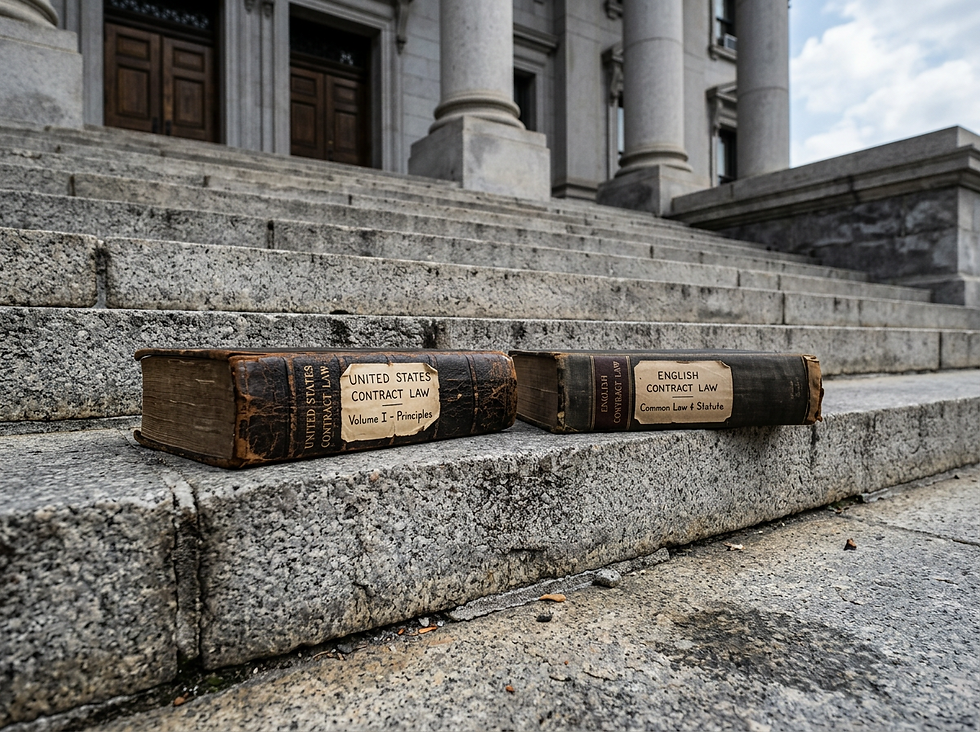
This split helps explain many modern disputes. A person comparing contract systems may find the topic framed as Comparative Analysis: US vs. English Contract Law Explore the similarities and differences between US and English contract law systems. Both systems share common law roots, but they developed different rules through courts, statutes, and legal culture.
The twentieth century made rights global
Two world wars forced a new legal question. Could law restrain states themselves?
The answer came through international courts, treaties, human rights documents, and constitutional reforms. The results remain uneven. Still, the legal vocabulary changed.
Human rights law changed the subject of protection
In 1948, the Universal Declaration of Human Rights set out a broad statement of human dignity, equality, liberty, and social rights. It was not a court judgment. It was not a complete legal system. It still became a reference point for later treaties, constitutions, and movements.
Eleanor Roosevelt chaired the drafting committee. Her role is a useful reminder that legal history is not only the work of kings and judges. Diplomats, campaigners, scholars, survivors, and communities also shape law.
Human rights law changed the position of the individual. A person could be seen not only as the subject of a state, but as a rights holder under wider principles.
Constitutional courts checked political power
Many modern states created written constitutions and courts with the power to review government action. The details vary. The shared idea is that some legal rules sit above ordinary politics.
This idea echoes older claims, from Magna Carta to natural rights theory. Yet modern constitutional review gives it a formal court setting.
Courts can strike down unlawful state action. They can protect speech, equality, fair trial rights, privacy, and due process. They can also face hard criticism when people think judges have gone too far.
That tension is part of modern law. Courts must protect legal principle, but they also operate in political societies.

The measurable results show which ideas survived
This case study can be measured by the survival of legal tools. Many began in one culture and later changed form.
Legal milestone | Approximate date | What changed | Modern trace |
Early Mesopotamian codes | Third to second millennium BCE | Written laws addressed daily disputes | Public statutes and legal records |
Code of Hammurabi | Eighteenth century BCE | 282 laws linked royal power to public justice | Written codes and proportional punishment |
Twelve Tables | Fifth century BCE | Roman citizens gained public legal rules | Open access to law |
Athenian reforms | Seventh to sixth century BCE | Law moved into civic debate | Citizen participation and public trials |
Roman jurists | Republic and empire | Legal reasoning became a trained craft | Contract, property, procedure, legal categories |
Justinian’s compilation | Sixth century CE | Roman law was preserved and organised | Civil law systems and university legal study |
Magna Carta | 1215 | Royal power faced legal limits | Due process and rule of law traditions |
English common law | Medieval period onwards | Courts built rules through decisions | Precedent and case law |
Napoleonic Code | 1804 | National civil code unified private law | Modern codification |
Human rights instruments | Twentieth century | Individual rights gained global language | Modern rights claims and constitutional law |
These results are not just academic. They shape daily life.
A rental agreement depends on contract rules. A will depends on inheritance law. A criminal charge depends on evidence and procedure. A protest depends on rights of speech and assembly. A court appeal depends on records and reasons.
Ancient ideas still stand behind these ordinary acts.
Notable figures turned legal pressure into legal change
Legal history often looks like a list of codes. People made those codes matter.
Hammurabi used law to project order
Hammurabi ruled a growing kingdom. His code helped present him as a guardian of justice. It was also a political tool. Public law helped bind different communities under one royal authority.
His legacy is not that he created fair law for all. He showed the power of law as public statecraft.
Solon reduced conflict by changing debt law
Solon’s reforms show law as a pressure valve. Debt had become a social danger. By changing the legal status of debt bondage, he reduced the risk of collapse.
The lesson remains current. Private law, such as debt and property rules, can decide public stability.
Cicero linked law with reason
The Roman statesman Cicero wrote about law, justice, and the republic. He argued that true law was connected to reason and nature, not only command.
Later thinkers used similar ideas to argue that unjust rule could be judged by higher principles. Cicero did not design modern rights law, but his language helped feed it.
Justinian saved a legal inheritance
Justinian wanted imperial order. His legal commission preserved centuries of Roman law. Without that work, later Europe would have had a thinner legal memory.
His achievement shows the value of compilation. Collecting old law can create new law.
Henry II made justice administrative
Henry II’s reforms were not romantic. They were administrative. Judges travelled. Records grew. Royal courts expanded.
That made law more consistent. It also gave the crown more power. Legal development often carries this double edge. Order and control can grow together.
William Blackstone made law teachable
Blackstone’s Commentaries organised English law for students and readers. Clear explanation made the common law exportable.
That mattered in places shaped by English legal influence. It also affected later debates about rights, property, crime, and courts.
Eleanor Roosevelt helped give rights a global voice
Roosevelt’s work on the Universal Declaration of Human Rights linked legal drafting with moral urgency after war. The declaration became a shared language for people challenging oppression.
It did not enforce itself. No legal text does. It still gave later movements a tool.
The approach changed from punishment to process
Early law often focused on punishment and compensation. Who pays? Who suffers? Who has authority?
Modern law still asks those questions. But it adds another one. Was the process fair?
This shift is one of the largest changes in legal history.
A fair legal process includes several ideas:
The law should be public.
People should know the accusation against them.
Courts should hear both sides.
Judges should give reasons.
Punishment should follow law, not personal anger.
Similar cases should receive similar treatment.
The state should follow its own rules.
These ideas grew slowly. Ancient courts did not meet modern standards. Medieval courts mixed ritual, religion, force, and custom. Early modern courts could still be brutal.
Yet the direction of legal argument changed. Over time, more systems accepted that justice is not only the result. It is also the method.
A person wrongly convicted after a poor hearing has not received justice, even if the law on paper looks fair.
The impact on modern courts is direct
Modern courts carry marks from many past systems.
From Mesopotamia, they inherit the value of written rules.
From Rome, they inherit legal categories and structured reasoning.
From religious traditions, they inherit concern with duty, conscience, family, and moral order.
From medieval England, they inherit precedent, juries, and the idea that courts can limit power.
From Enlightenment reformers, they inherit proportionate punishment and suspicion of arbitrary authority.
From modern rights movements, they inherit equality claims and human dignity.
No modern system is pure. A court in England and Wales uses statutes, case law, procedure, and rights principles. A civil law court in continental Europe uses codes, judicial reasoning, constitutional standards, and human rights norms. Many countries have mixed systems, shaped by custom, religion, colonial history, local reform, and international law.
That mixed inheritance explains why legal history still matters. When courts argue over privacy, speech, contracts, protest, punishment, or equality, they often reuse old tools in new settings.
The recurring problem is who law protects
Every era claims to seek justice. The hard question is who receives it.
Hammurabi’s code treated people by rank. Athens excluded most residents from citizenship. Roman law accepted slavery. Medieval law often tied rights to status. Colonial legal systems frequently displaced local law and denied equal protection. Modern systems still struggle with access, cost, delay, bias, and unequal outcomes.
This does not make legal progress false. It makes it contested.
The rule of law means more than having rules. Harsh regimes can have rules. A stronger ideal includes:
Public laws.
Fair procedures.
Independent courts.
Limits on officials.
Equal protection.
Real access to justice.
The last point is vital. A right that cannot be used is weak. Courts, lawyers, legal aid, clear language, and fair costs all affect whether law works in practice.
The modern case study result is a layered system
The history of legal systems did not produce one final model. It produced layers.
A modern legal dispute may involve:
A written statute.
A court precedent.
A contract.
A constitutional right.
A human rights principle.
A local rule.
A judge’s interpretation.
A procedure for appeal.
That layered structure can frustrate people. It can feel slow and complex. It also protects against simple power.
If one official could decide every dispute without rules, law would be quick. It would also be dangerous.
Modern courts are slow because they carry centuries of caution. They ask for notice, evidence, argument, reasons, and review. Those steps are not decoration. They are the memory of past abuses.

Lessons from legal history that still apply
This case study offers four practical lessons.
Written law is powerful, but it is not enough
Hammurabi, Draco, Rome, and Napoleon all show the force of written law. Written rules can reduce uncertainty. They can also preserve unfairness.
A legal system needs more than text. It needs fair interpretation, access, and limits on power.
Procedure protects people from raw authority
The move from ordeal to jury trial, from secret custom to public courts, and from command to review all point to one lesson. Process matters.
A fair hearing is not a technical luxury. It is a shield against abuse.
Legal systems borrow more than they admit
Roman law shaped civil law. English common law spread through empire and influence. Religious law shaped family and moral duties. Human rights law moved across borders.
Modern law is not sealed inside national borders. It carries older borrowings.
Justice expands when excluded people force the question
Many legal advances came because people challenged the system. Debtors, common citizens, religious minorities, workers, women, enslaved people, colonised peoples, and civil rights campaigners all pushed law to face its own claims.
Legal history is not only made by rulers. It is also made by those who demand that law mean what it says.
FAQ
What is the oldest known legal code?
Some of the oldest known legal codes come from ancient Mesopotamia. The Code of Ur-Nammu is often described as older than the Code of Hammurabi. Hammurabi’s code is more famous because its stele survived in striking form and contains 282 laws.
Why is Roman law still important?
Roman law shaped later civil law systems and gave later lawyers clear ways to think about contracts, property, inheritance, and legal procedure. Justinian’s sixth-century collection helped preserve Roman legal thought for medieval and modern Europe.
What is the difference between civil law and common law?
Civil law systems rely heavily on written codes. Common law systems rely on statutes and court decisions, with earlier cases guiding later ones. Modern systems often mix both methods.
Did Magna Carta create modern rights?
No. Magna Carta began as a settlement between King John and rebel barons in 1215. Its later importance came from how people used it as a symbol of lawful government, due process, and limits on rulers.
Why does legal history matter today?
Modern courts still use ideas that developed over centuries. Written law, precedent, fair process, rights, contracts, and limits on government all have deep roots. Knowing that history makes modern legal debates easier to understand.
The long story of law is the struggle to make power answerable
The history of legal systems is not a march of perfect progress. It is a record of experiments, failures, reforms, and hard-won principles.
Hammurabi made law visible. Athens made it public debate. Rome made it a craft. Religious traditions tied it to duty. Medieval England built precedent. Modern reformers demanded rights and limits on power.
The lasting result is clear. Law works best when it does more than command obedience. It must give reasons, hear both sides, protect the weak from the strong, and bind rulers as well as citizens.
That is the epic thread from ancient stone to modern courts.


Comments